FIELD NOTES / REPRODUCIBLE, WITH LIMITS
Behind the plate.
One illustration. A recorded encoder. Files you can inspect.
The working set
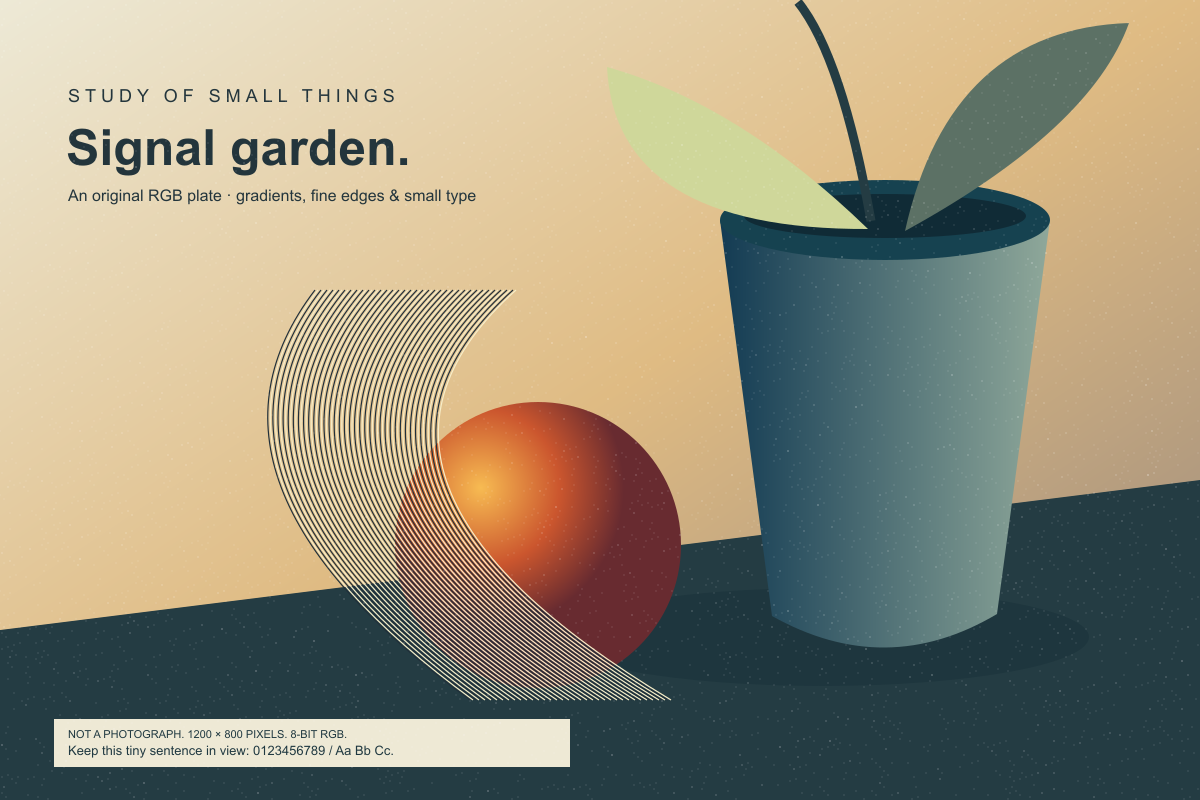
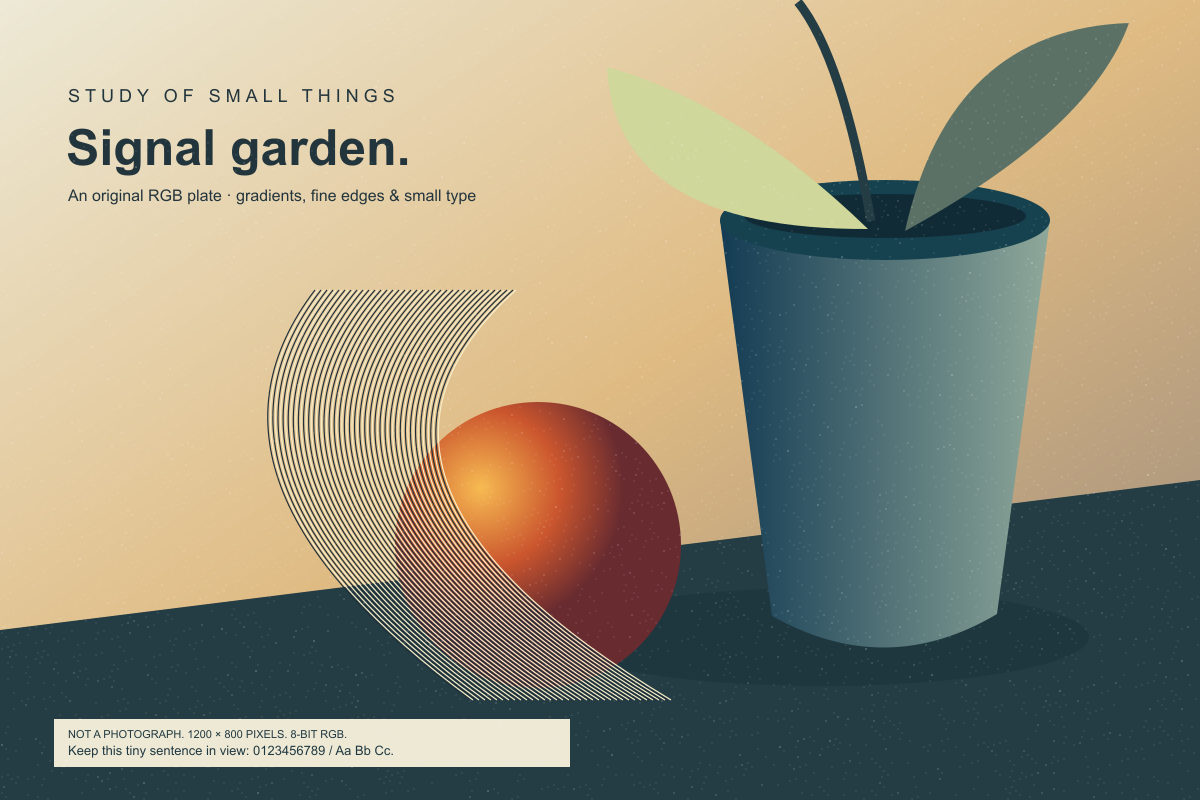
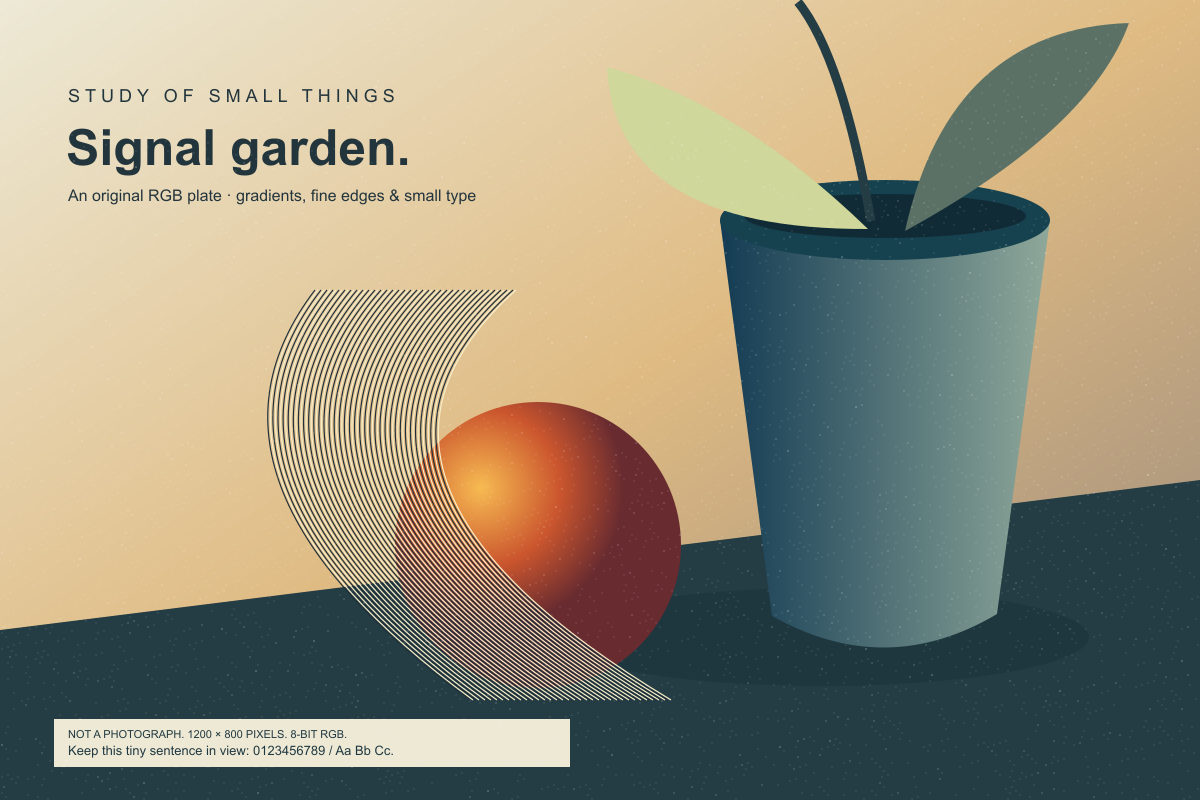
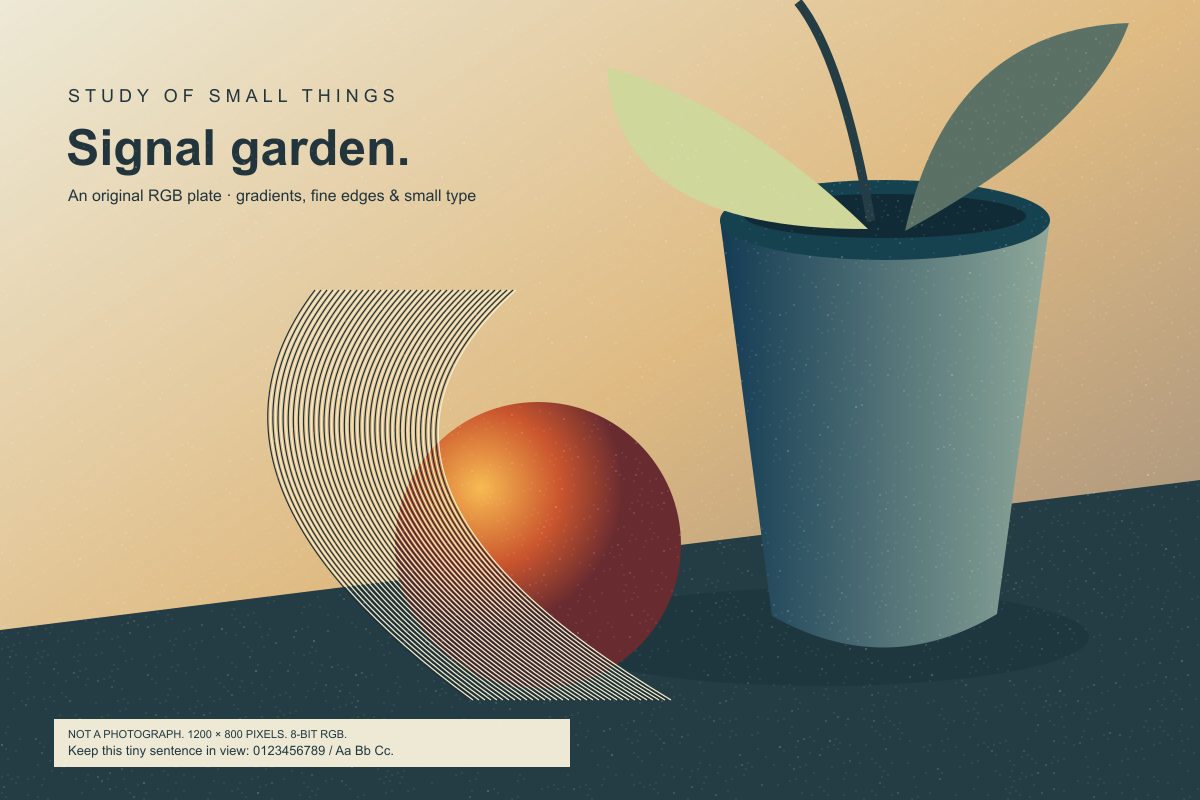
All sample artwork is original code-drawn material released under CC0 1.0. It is not a photograph, borrowed benchmark or customer image. JXL downloads may need a compatible viewer; the page’s crop comparisons use PNG instead.
- source.png
- 296,370 bytes · the 8-bit RGB starting image.
- lossless.jxl
- 251,953 bytes · distance 0, exact decoded RGB in this test.
- distance-1.jxl
- 93,706 bytes · distance 1, perceptual lossy encoding.
- distance-4.jxl
- 41,411 bytes · distance 4, greater permitted distortion.
- source.jpg / restored.jpg
- 133,370 bytes each · the byte-identical pair.
- jpeg-preserved.jxl
- 92,291 bytes · the JPEG reconstruction path.
- quality-100.jpg
- 654,553 bytes · newly encoded JPEG, not the original bytes.
- signal-garden.svg
- The original vector drawing. Font rendering can vary across systems.
- Measurements & hashes
- Sizes, SHA-256, RGB differences and crop coordinates.
- Executed command log
- Actual arguments, exit statuses and tool output.
- Sample generator / Read me
- Node + sharp source and reproduction notes.
How we made the comparison
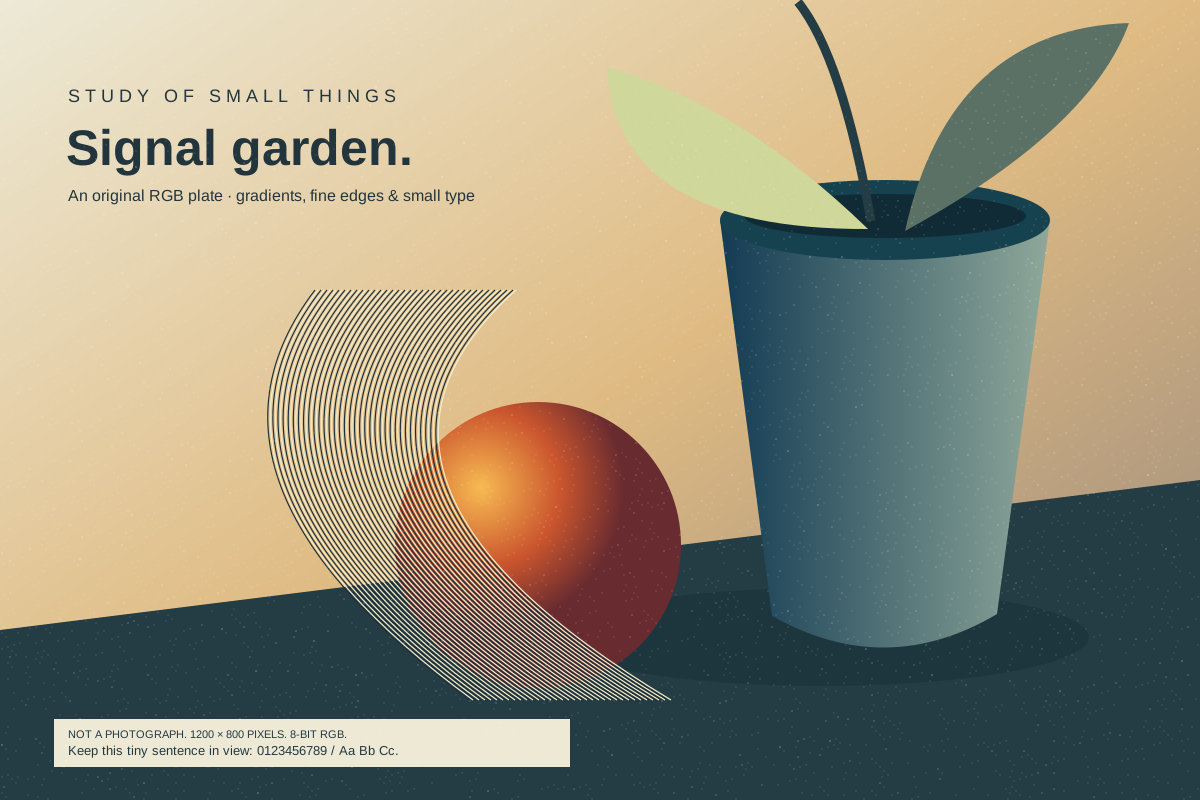
We rendered a deterministic SVG drawing to a 1,200 × 800, three-channel, 8-bit sRGB PNG. The drawing deliberately combines flat colour, gradients, added fine grain, small text and tightly spaced lines. It helps reveal different kinds of change, but its mix is artificial.
Using native libjxl 0.12.0 on ARM64 macOS (Homebrew 0.12.0_1), we encoded the same PNG at effort 7 with distances 0, 1 and 4, then decoded each JXL to PNG. These are completed native runs, not a simulated browser conversion.
cjxl source.png lossless.jxl -d 0 -e 7
cjxl source.png distance-1.jxl -d 1 -e 7
cjxl source.png distance-4.jxl -d 4 -e 7
djxl lossless.jxl lossless.png
djxl distance-1.jxl distance-1.png
djxl distance-4.jxl distance-4.png
We decoded those PNG files to raw RGB using sharp and compared 2,880,000 channel samples. Mean absolute error is the sum of absolute per-channel differences divided by that count. Maximum error is the largest channel difference. Neither is a perceptual score. No alpha channel was included, and no cross-browser colour-conformance claim follows from this local calculation.
Crop positions are fixed: type starts at (60, 718) and measures 230 × 55 pixels; fine edges at (380, 430), 160 × 110; gradient at (525, 475), 160 × 110. Each crop is enlarged three times with nearest-neighbour scaling. Browser resizing and display density can affect what you see; use the downloadable source files for your own inspection.
The JPEG experiment starts from a separate JPEG encoding of our PNG, created with quality 82 and 4:4:4 chroma sampling. We preserved that JPEG in JXL, reconstructed it with an explicit fail-if-unavailable option, and compared bytes and SHA-256. We also forced a new quality-100 JPEG encoding to demonstrate the difference. See the exact round trip.
What we did not test
Camera metadata collections, animation, transparency, HDR, 16-bit or floating-point images, progressive network decoding, large files and every decoder implementation. There is no universal compression, compatibility or archival guarantee here. The illustrated page does not upload or convert visitors’ images.
Primary references
- Chrome: shipping JPEG XL — October 6, 2026; dated browser rollout, not the invention of the format.
- Firefox 158 developer notes — October 13, 2026; current release behavior.
- libjxl 0.12.0 release — the native version used here, including explicit JPEG reconstruction.
- cjxl manual and djxl manual — encoding distance and JPEG output options.
- JPEG XL community test page — a separate native browser-format reference. Our PNG crop study is not a replacement for it.
Our measurements and original files were checked on October 15, 2026, local time. Browser capabilities can change after publication. Corrections: support@cleantempmail.com.
Who publishes this, and what is sent?
PixelKeep is an independent MoneyHunter publication. It is not an official JPEG, browser-vendor or former-organisation website. The old domain’s name is not used as an endorsement or source of technical authority.
The detail buttons switch between fixed public images. There is no account, payment, uploaded file, analytics script or local-storage history. Cloudflare delivers the pages and receives ordinary request metadata. Downloaded samples stay wherever you save them.
The publishing article links to WebTraceCheck and CleanTempMail, which share our operator. Referral URLs include the site, topic and link placement; they contain no image data or personal input. Those services have their own policies and limits. The site itself needs no external paid API.